



In Japan, rent is generally paid in one of five ways: direct debit, bank transfer, convenience store payment, cash in person, or credit card.
In short: choose direct debit if you want the least monthly effort, bank transfer if you want to control the timing yourself, and convenience store payment if you cannot get to a bank during the day. Paying by credit card lets you defer the payment to the following month and earn points, but only a limited number of properties accept it.
Keep in mind that tenants cannot always choose freely. The payment method is usually specified in the lease agreement or by the management company. This guide compares all five by effort, cost and cautions, then explains how to pay at a convenience store step by step, and what to do if your property does not accept credit cards.
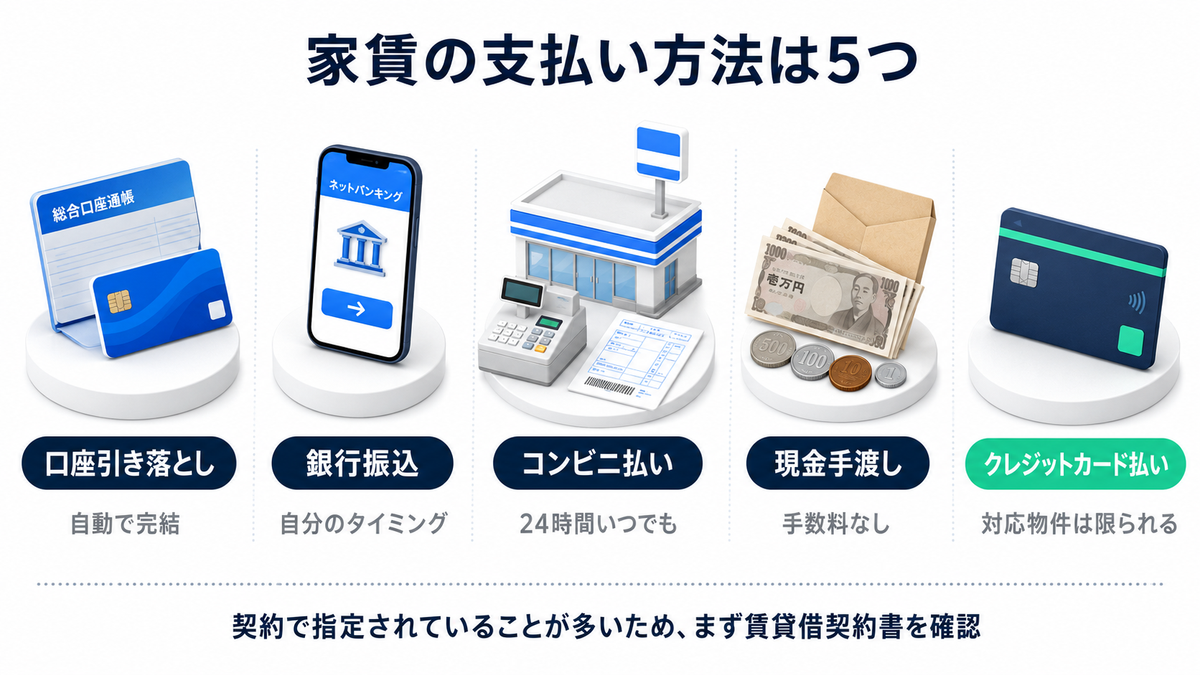
The five rent payment methods at a glance
Costs vary depending on your contract, your bank and the management company, so always confirm the exact amounts in your lease or with the management company.
| Payment method | Monthly effort | Cost | Main caution |
|---|---|---|---|
| Direct debit | Almost none (automatic) | A handling fee may be set in your contract | Payment fails if your balance is short |
| Bank transfer | You transfer it yourself each month | Transfer fee (varies by bank and method) | Easy to forget; you manage the due date |
| Convenience store | Pay at the register each month | A fee may be included in the payment slip | Lost slip or expired due date |
| Cash in person | Meeting the landlord each time | Usually none | Scheduling burden; keep the receipt |
| Credit card | Almost none (automatic) | Fees set by the card issuer or service | Only available at properties that accept it |
1. Direct debit (automatic bank withdrawal)
Rent is withdrawn automatically from your registered bank account on a fixed day each month. Where the management company offers it, this is the standard method for many properties.
Best for: people who want to remove the monthly task entirely, or who worry about forgetting.
Advantages
- Set it up once and it runs automatically
- In many cases there is no monthly transfer fee
Cautions
- If your balance is short, the withdrawal fails and it is treated as a missed payment. Check how your payday lines up with the withdrawal date
- Registration with the bank can take time, so you may be asked to pay by transfer for the first few months
2. Bank transfer
You transfer the rent yourself each month to the account specified by the landlord or management company.
Best for: people who want to control the timing, or who have just moved in and have not completed direct debit registration.
Advantages
- A clear record of payment remains
- You can pay whenever it suits you, as long as it is before the due date
Cautions
- The transfer fee is usually paid by the tenant. It varies by bank, time of day and whether the transfer is within the same bank, so online banking can reduce it
- Use the contract holder's name as the sender (or room number plus name, as instructed). If the name does not match, the payment may not be identified and you could receive a reminder
3. Convenience store payment
You pay at a convenience store register using a payment slip sent by the landlord or management company.
Best for: people who cannot reach a bank counter or ATM during opening hours, or who prefer to pay in cash.
How to pay rent at a convenience store
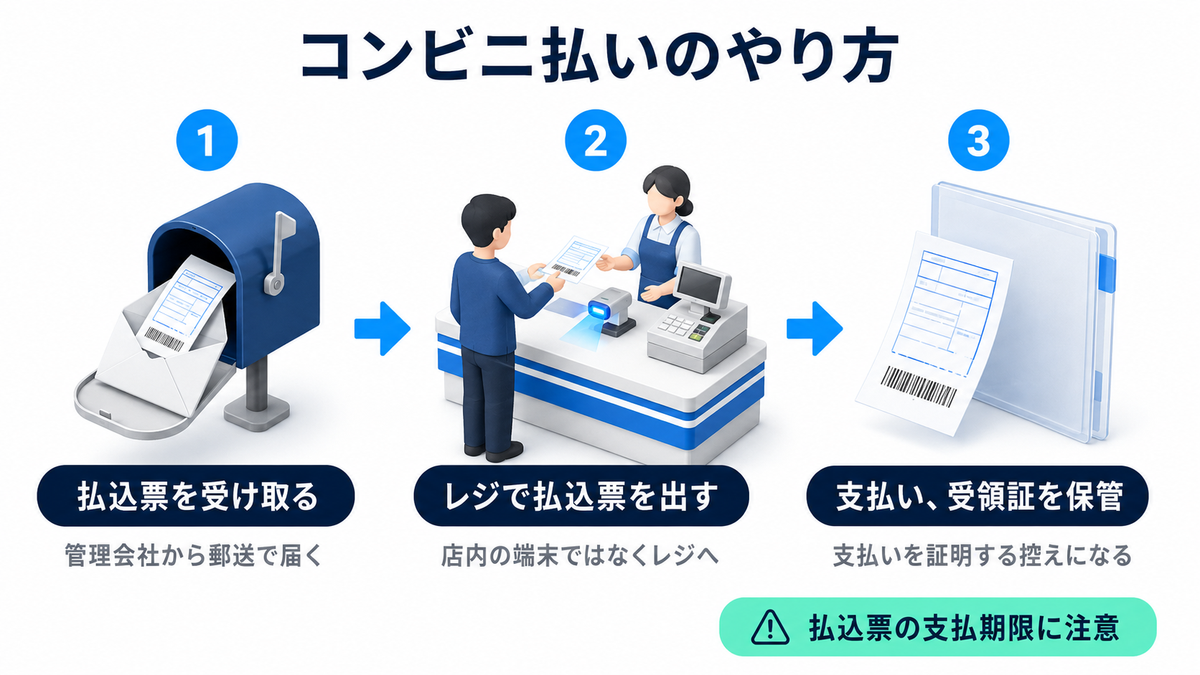
- Receive the payment slip — it is mailed to you monthly, or several months at a time
- Hand the slip to the cashier — the barcode is scanned at the register. Take it directly to the register, not to the in-store multi-copy machine
- Pay and keep the receipt — the receipt you are handed is your only proof of payment. Keep it until your next lease renewal
You can pay 24 hours a day, but you must pay before the due date printed on the slip. After that the barcode can no longer be scanned, and you will need to contact the management company for a reissue.
Can you pay by credit card at a convenience store?
In most cases, no. Payment slips are processed through a collection agency system, and payment is generally cash only. Whether electronic money or QR code payments are accepted also differs by store chain and slip type.
So you cannot simply keep paying at the convenience store and start earning card points. If you want to pay by card, see the method described below.
If the slip does not arrive or the due date has passed
If your slip does not arrive, is lost, or has expired, contact the management company rather than leaving it. A recorded missed payment can affect your lease renewal or a future tenant screening. Reissuing takes several days, so get in touch as soon as you notice.
4. Cash in person
You hand cash directly to the landlord. This is still seen with individually owned properties.
Advantages: no fees, and you can speak with the landlord directly.
Cautions
- Always ask for a receipt. Cash leaves no record, so the receipt is your only protection against a dispute over whether rent was paid
- You need to arrange a time every month, and there is a risk of loss or theft
5. Credit card payment
You pay rent with a credit card. The payment is automated and qualifies for your card's points.
Only a limited number of properties accept cards
Rent can only be paid by card at properties where the landlord or management company has adopted the system. Even if you would like to pay by card, it is often simply not offered when you sign the lease.
This is due to the landlord's side of the equation, such as processing costs and payment cycles. It is not something a tenant can switch on alone.
How to use a credit card at a property that does not accept them
Even if your property does not accept cards, there are services that let you switch your rent payment to a credit card. RentEase is one of them.
The mechanism is simple: you pay RentEase by credit card, and RentEase transfers the rent to your landlord or management company. The transfer is made on the 25th of each month, under the tenant's (contract holder's) name.
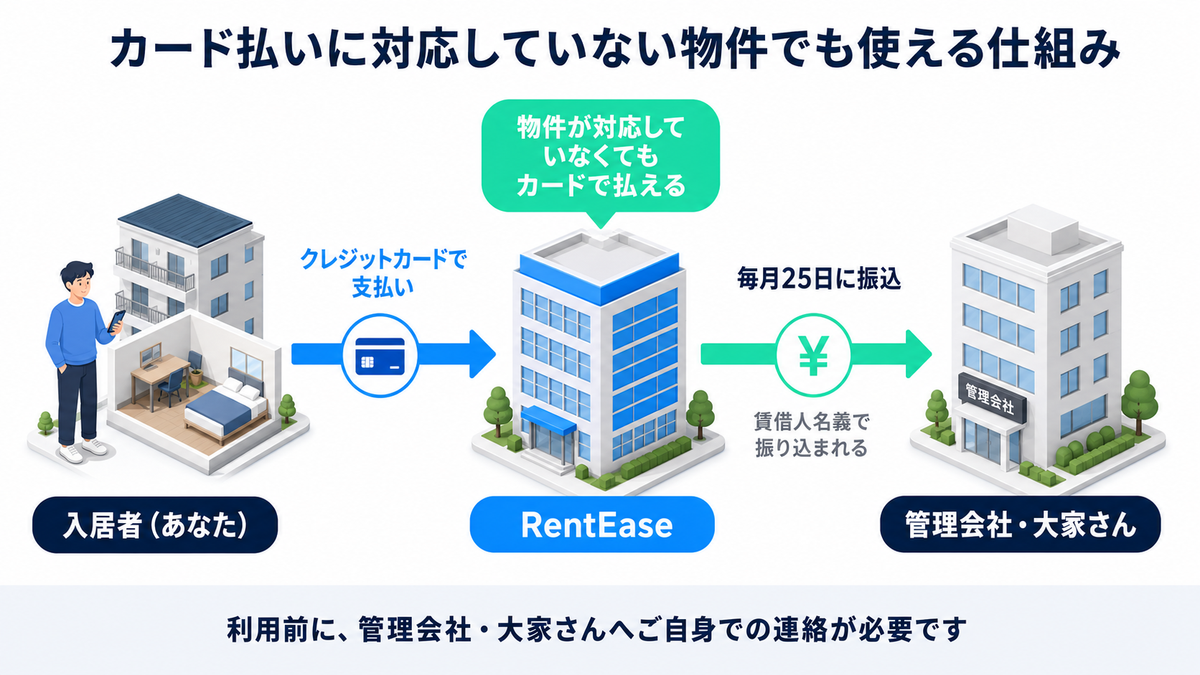
This suits you if
- Your property does not accept cards, but you want to pay by card
- You want to defer payment to your card's billing date
- You want to use a card only in certain months, not every month
Good to know
- Accepted brands are VISA, Mastercard, JCB and American Express
- Properties with monthly rent up to 5 million yen are eligible, both residential and commercial. Management fees, common area fees and renewal fees (in the month the renewal fee is due) can also be paid
- A service fee applies. Please check the latest fees and conditions on the official website
- Your card statement will show "RentEase" (or "ALLIANCE GATEWAY" for American Express)
- Points are awarded according to your card issuer's terms. Reward rates differ by issuer
You must contact your landlord or management company first
This is the most important point. If you use this type of service, you need to contact your landlord or management company yourself (RentEase does not make the contact on your behalf).
- If you currently pay by direct debit: tell them you want to change from direct debit to bank transfer, and confirm the transfer details. Also let them know that the transfer will arrive on the 25th of each month
- If you currently pay by bank transfer: simply tell them that the transfer date will change to the 25th of each month
This is not something you switch on without telling anyone — it is a service you use after informing the other party of the change. Starting without notice can lead to confusion over incoming payments and suspicion of a missed payment.
Note that the first payment is processed when you register your card. Depending on the date you register, the first transfer will be made either on the 25th of the current month or the following month; if it falls in the following month, you must pay the current month's rent yourself. Check carefully in the month you switch so you do not pay twice.
How to choose the right method for you
- Least effort → direct debit, but keep an eye on your balance
- Control over timing → bank transfer, watching fees and due dates
- Cannot get to a bank during the day → convenience store, managing the due date and receipt
- A clear record → bank transfer (or always take a receipt when paying cash)
- Pay by card or defer to next month → a card-friendly property, or a switching service if yours is not
The first thing to check is which method your own lease specifies. Read your contract, and if you want to change it, start by talking to your management company.
Frequently asked questions
Q. Can I change the payment method partway through the lease?
A. It may be possible with the consent of the landlord or management company. Check your contract first, then consult them.
Q. Can I use a credit card at a convenience store?
A. Payment slips at convenience stores are generally cash only, so in most cases a card cannot be used.
Q. Do I earn points if I pay rent by credit card?
A. Points are awarded according to your card issuer's terms. Reward rates differ by issuer.
Q. Can I pay by card at a property that does not accept cards?
A. You can use a service that switches the rent payment to a credit card. You will need to contact your landlord or management company yourself.
Summary
Rent in Japan is paid by direct debit, bank transfer, convenience store, cash in person, or credit card. Direct debit takes the least effort, bank transfer gives you control over the timing, and convenience store payment offers the most flexible hours.
Paying by card lets you defer payment and earn points, but only a limited number of properties accept it. If yours does not, a service that switches the payment to a credit card is an option. In that case you must contact your landlord or management company yourself and let them know that the transfer will arrive on the 25th of each month.
Start by checking your lease agreement to see which method currently applies to you.